Centrios
Product/Platform: Centrios
My Role: Lead Product Designer, Experience Strategy
Team: Engineering Manager, Product Manager, Business Analyst, Developers, UI/UX Designers, Architects, Software Testers
Year: 2023 - Present
Overview
Centrios is a cloud-based access control platform that enables small business to manager devices and users across multiple locations.
When I joined the team, the product had recently launched but was struggling with inconsistent experiences across web and mobile, unclear access workflows, and low product adoption.
Structural UX Challenges -
-
Inconsistent web and mobile experiences
-
No single source of truth for product design decisions
-
Confusing interaction model between devices, locks, and mobile credentials
-
Low adoption and weak user retention
-
Poor scalability for managing teams and users
My Role
As the Lead UX/UI Designer, I saw an opportunity to apply systems-thinking approach connecting users, devices, and access management into one cohesive ecosystem. By driving a unified UX strategy focused on clarity, scalability, and usability, we began to boost adoption, improve retention, and support sales growth through a more seamless and trustworthy experience across platforms.
My responsibilities included:
-
Defining the experience strategy
-
Designing key access management workflows
-
Establishing product design standards
-
Collaborating with Product and Engineering to align interaction models across platforms.
Impact So Far
The goal wasn’t just to redesign screens or ship features. It was to measurably improve operational performance.
↓ ~40% reduction in admin task time - Introduced group-based access controls that eliminated repetitive device-level configuration, reducing time-on-task across high-frequency admin actions by ~40%.
↑ ~25% improvement in task success - Simplified permission logic and credential assignment, improving task completion rates by ~25% in structured usability testing.
↓ ~40% reduction in configuration errors - Reduced manual misconfiguration by centralizing access logic into scalable group structures
Onboarding - User App Guide
New Owners and Managers often lacked confidence during their first interactions with Centrios, particularly during initial setup. I led end-to-end design of an App Guide to introduce key workflows and help users get started with clarity. I collaborated with product and engineering to prioritize and scope the feature, and ensure technical feasibility. While the original concept was an interactive product tour, implementation constraints led us to ship a carousel-based guide that highlighted core functionalities and provided a lightweight, scalable onboarding experience.
Prototype


Prototype
Lock/Unlock Page & Navigation - Before
The Lock & Unlock page relied on a static image to explain a physical interaction, which caused repeated user errors during testing. Users consistently mispositioned their phones, leading to failed lock and unlock attempts, while unclear navigation icons created hesitation and incorrect flows. The core issue was that a static visual could not effectively communicate a motion-based action, and the iconography did not match users’ mental models.

Prototype


Lock/Unlock Page & Navigation - After
To address this, I replaced the static image with an animation that clearly demonstrated the correct phone-to-lock interaction and redesigned the navigation icons to better communicate actions and destinations. This reduced user confusion at the point of action, improved first-time success rates, and increased confidence and speed during one of the most critical moments in the product experience.

Prototype


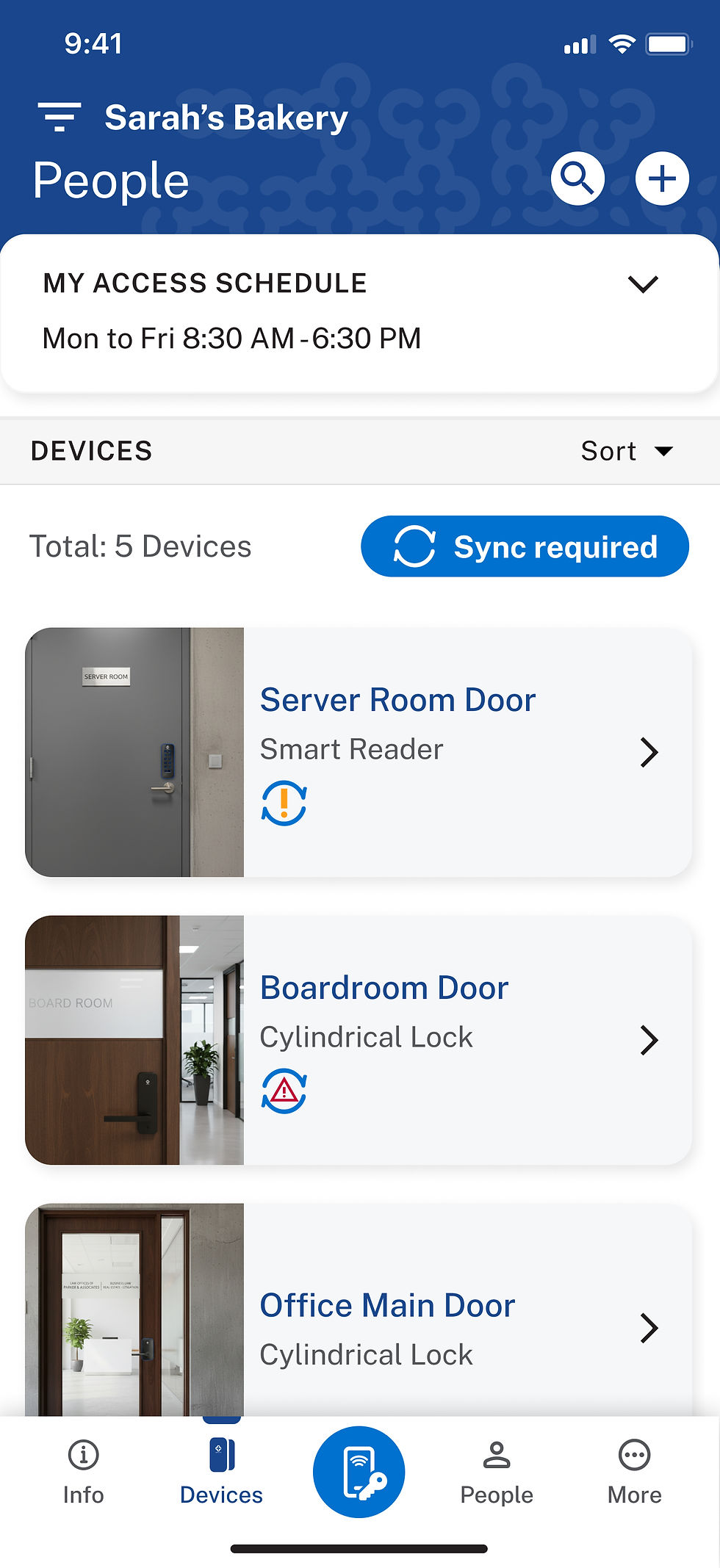
User Management -
Inviting a Person (Custom Access)
Centrios allows Owners and Managers to invite a person by assigning access at an individual level. During this process, they can define the user’s role, assign secure credentials, assign specific devices, and apply access schedules to control when permissions are active. This approach offers full control and is ideal when a user requires custom access based on their responsibilities. Once configured, the invitation is sent and the user gains access exactly as defined.

Prototype

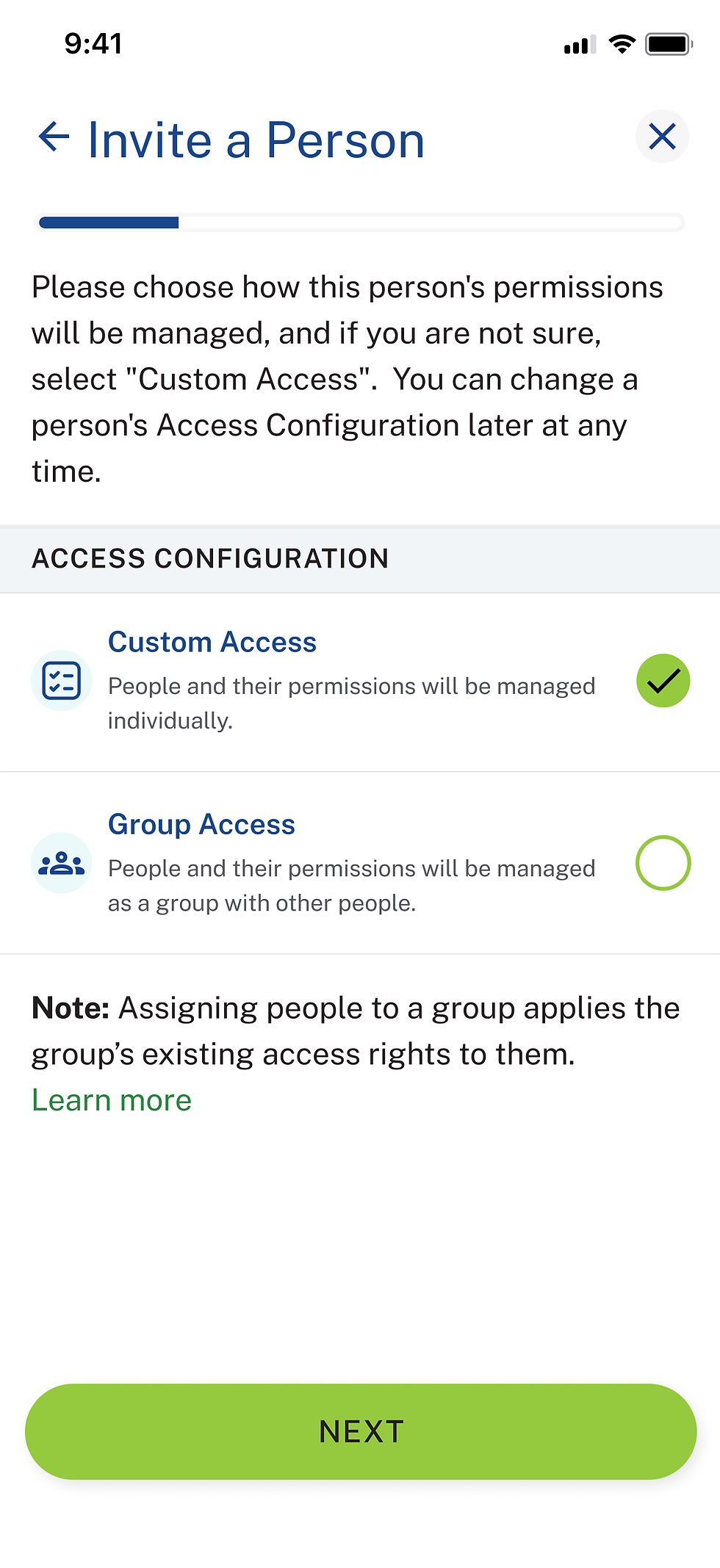


User Management -Inviting a Person (Group Access)
As the platform scaled, it became clear that Owners and Managers needed a faster, more efficient way to onboard multiple users with similar access needs. I led the design of Group Access Invitations, built on People Groups with predefined roles, devices, and schedules. Instead of repeating the full setup for every user, Owners and Managers can now simply assign a person to a group. The user automatically inherits the group’s access rights, and the invitation is sent instantly. This significantly reduces setup time, ensures consistency across teams, and makes user management scalable and error-free.
Prototype


User Management -
Creating a People Group
To support teams managing access at scale, I designed the People Groups system in Centrios. Instead of assigning roles, credentials, devices, and schedules to users indivdually, Owners and Managers can define these permissions once at the group level. Each group acts as a reusable access template, ensuring consistency and reducing repetitive configuration.
Once a group is created, users can be added in seconds and automatically inherit the group’s access rights. This enables bulk operations, faster onboarding, and fewer setup errors—making user management more efficient while maintaining clear, centralized control over permissions.
Prototype


Device Management - Add Device
When I joined the Centrios team, device enrollment flow was solely scanning a QR code to decode and add a device. While functional, this approach assumed all devices followed the same setup flow. I identified an early scalability risk and led the introduction of an initial device type selection step before enrollment, creating a structured foundation for supporting multiple device categories.
This change proved critical as new devices, such as the padlock with a distinct setup flow, were introduced. By separating device identification from configuration, Owners and Managers gained clearer guidance during enrollment, faster setup, and fewer errors. The new structure also improved error handling and positioned Centrios to seamlessly support future device types and third-party integrations without redesigning the enrollment experience.
Prototype


Reflections
Designing Within Constraints
Centrios required designing within real technical and organizational limits.
During the migration from Xamarin to .NET MAUI, evolving framework constraints shaped interaction patterns and performance. I adapted flows, balanced trade-offs, and preserved usability within those realities. Strong design is intelligent compromise under constraint.
Asking “Why” Is the Lever
User frustrations weren’t UI problems — they were structural workflow issues.
By repeatedly asking why errors and delays were happening, I uncovered the underlying system bottleneck and reframed the problem at its root. The first solution isn’t the answer; it’s the doorway to better questions.
Cross-Disciplinary Presence
UX maturity doesn’t come from critique sessions alone. It grows when design participates in architecture, understands technical constraints, and aligns with operational and business realities.
Centrios required proactive involvement across disciplines. Design influence grows through involvement.
Adapting the Process
A rigid process would have failed in this environment.
Centrios required iterative validation, lightweight testing, and continuous refinement alongside development. Flexibility made the process scalable, not weaker.
Navigating a Dev-First Culture
In a development-led environment, design decisions were often challenged.
I reframed that resistance as a gap to bridge — educating teams through clear trade-offs and evidence-based reasoning. Influence came from clarity, not authority.
Designing Without a Fully Mature Design System
The evolving design system wasn’t prioritized, which limited large-scale UI transformation.
I had to balance progress with restraint — improving workflows without deepening visual and interaction inconsistencies. Constraint required discipline, not overreach.
Centrios
Centrios
Centrios
Centrios
Centrios
Impact So Far
The goal wasn’t just to redesign screens or ship features. It was to measurably improve operational performance.
↓40%
Faster Task Completion
Introduced group-based access controls that eliminated repetitive device-level configuration, reducing time-on-task across high-frequency admin actions by ~40%.
↑25%
Higher Task Success
Simplified permission logic and credential assignment, improving task completion rates by ~25% in structured usability testing.
↓40%
Fewer User Errors
Reduced manual misconfiguration by centralizing access logic into scalable group structures.
Centrios
↑36%
Month-on-Month Engagement
Introduced group-based access controls that eliminated repetitive device-level configuration, reducing time-on-task across high-frequency admin actions by ~40%.