Centrios Onboarding
Product/Platform: Centrios
My Role: Lead Product Designer, Experience Strategy
Team: Engineering, Product, Architects, QA, Marketing, Customer/Support stakeholders
Period: 3 months
Overview
Centrios is a cloud-based access control platform used by system owners, managers, credential holders, report viewers, and installation partners.
A recurring onboarding problem was creating friction for one of our most common user groups: invited users were mistakenly creating new systems instead of joining the systems they had been invited to.
My Role
I led the redesign end-to-end—from identifying patterns in recurring support issues and reframing the onboarding problem to exploring, validating, and delivering the final experience.
I partnered with Product, Engineering, QA, Architects, Marketing, and Support stakeholders to understand where invited users were getting stuck, assess technical constraints, and iterate through three design directions. I ultimately shifted the experience from account-based navigation to intent-based onboarding, creating clearer entry paths for invited users, existing users, new Owners, and Centrios Partners.
My contribution: Problem framing · Journey mapping · UX strategy · User flows · Interaction design · Prototyping · Design iteration · Cross-functional collaboration · Design QA
Impact So Far
91% ↓ Invitation-related support tickets within 3 months of launch
↑ ~25% improvement in task success - Simplified permission logic and credential assignment, improving task completion rates by ~25% in structured usability testing.
↓ ~40% reduction in configuration errors - Reduced manual misconfiguration by centralizing access logic into scalable group structures
01. THE CHALLENGE
Invited users were entering through the wrong door
Centrios enables system Owners to invite managers, credential holders, and report viewers to access their systems.
After downloading the app, invited users were met with two options:
Log In or Owner Sign Up.
Many first-time users assumed they needed to sign up as an Owner. Instead of joining the system they were invited to, they unintentionally created a new system.

The original entry point
Hidden behind
"Log In"
Looks like the right way to get started
User Flow

The Impact
Failed or delayed activation
Accidental system creation
User confusion on
first user
Increases support
tickets
02. DEFINING THE PROBLEM
We were asking users the wrong question
Our original onboarding flow was structured around Centrios' account structure, but users thought about their intent.
Invited users weren't thinking about account types. They were thinking,“What type of Centrios account am I?”
That changed the design challenge from improving two buttons to reconsidering how users entered Centrios altogether.
What the product asked
What users actually knew
Access your account
Log In
I already have an
account
Create a new owner account
Owner Sign Up
I was invited to join a system
I want to create and set
up a new system
I'm setting up a system for my customer
How Might We Statement
How might we help users identify the right onboarding path without requiring them to understand Centrios' account structure first?
Key Insight
Users don't start with our mental model.
They start with their reason for being here.
The solution wasn't clearer buttons.
It was a new way to frame the decision.
03. EXPLORATION & ITERATION
Three hypotheses for a better entry model
I explored different ways Centrios could help users find the right onboarding path. Each iteration tested a different hypothesis and helped us learn worked, what didn't, and how to best support all user types.
The Goal: Help users get to the right place quickly and confidently.
Iteration 1: System-Led Routing
What if Centrios decided for you?
Users enter their email first and Centrios determines their account state, then routes them accordingly.
What we learned: It simplified initial decision, but added complexity behind the scenes and reduced transparency
.png)
.png)
User enters email; system verifies account status.
.png)
System detects account; routes to login.
.png)
No account detected; routes to signup.
Iteration 2: User-Led Routing
What if users told us why they're here?
Users choose the scenario that matches their situation so we can take them to the right flow
What we learned: Intent-based choices were clearer and made the invitation path visible, but we needed to explicitly cover partners and refinethe language.
.png)
User chooses the scenario that matches their situation
.png)
.png)
User chose
"I got an invite"
User chose
"I am an Owner"
Iteration 3: Guide Self-Selection (Final)
What if we guided users with clearer, complete options?
Provide all the key entry paths with clear language and guidance, especially for invited users.
Why this worked: It covers all major user intents, uses clear language, and emphasizes the path where users were making the most mistakes
User chooses the scenario that matches their situation
.png)
.png)
User chose
"I got an invite"
_edited.png)
User chose
"I'm a new Owner" or "I'm a Centrios Partner"
04. THE SOLUTION
Designing Onboarding around why users are here
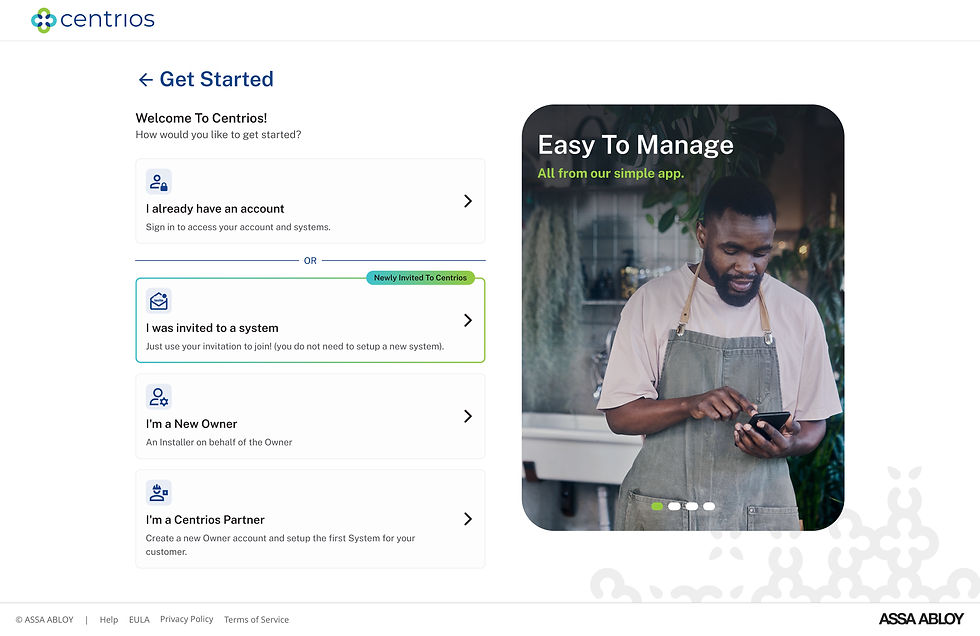
The final experience reorganized Centrios onboarding around four clear user intents, making it easy for users ti identify the path that matches their situation.
For returning Centrios users who already have an account
For users who are creating a new Centrios system.
For users who received an invitation to join a system
For partners setting up systems on behalf of customers
Design Principles
Make intent clear
for user.
Prevent mistakes for the user
Support all
users
Build confidence in making decision
05. BEFORE & AFTER
More choices. Less ambiguity.
The original experience looked simple with only two actions, but users had to interpret what they meant in the context of Centrios. The redesign introduced more visible choices while making the meaning of each choice instantly clear.
What changed? We shifted from asking users to understand our system to helping then identify their intent

BEFORE
Users don't know which option matches their situation
"Owner Sign Up" looks like the natural place to start.
Leads to unwanted sysrem creation, confusion, and support requests
AFTER
Users can choose the option that matches their situation.
Each path is labeled in language the users understand.
Guidance helps users avoid the wrong registration path
Faster activation with less confusion and less support.
BEFORE - WEB
BEFORE (Web App)


AFTER - WEB


06. OUTCOME
A clearer path from invitation to activation
The redesign addressed the problem at its source; the moment users decide how to enter Centrios. Invited users now have a dedicated path to join the system they were invited to, reducing errors and support dependency.
The goal? Help invited users join the right system quickly and confidently, without creating new ones or needing support.
Before
After

Impact
Since release, we've seen measurable improvements in onboarding success and support reduction.
91% ↓
Reduction in onboarding-related support tickets.
(First 90 days)
Fewer
Accidental system
creation by invited users.
(First 90 days)
Improved
Successful invited-user activation.
(First 90 days)
Faster
Path from invitation to first access.
(First 90 days)
07. REFLECTION
Simplicity isn't about having fewer choices
This project reinforced that a visually simple interface isn't necessarily a simple experience.
Our original onboarding had only two actions, but neither clearly reflected the context of many first-time users.
Through iteration, I moved from trying to have the system infer user intent to designing an experience where users could confidently express it themselves.
The result was a more transparent and scalable entry model for Centrios.
"Don't make users understand your system before they can use your system."
Centrios
Centrios
Centrios
Centrios
Centrios
Impact So Far
The goal wasn’t just to redesign screens or ship features. It was to measurably improve operational performance.
↓40%
Faster Task Completion
Introduced group-based access controls that eliminated repetitive device-level configuration, reducing time-on-task across high-frequency admin actions by ~40%.
↑25%
Higher Task Success
Simplified permission logic and credential assignment, improving task completion rates by ~25% in structured usability testing.
↓40%
Fewer User Errors
Reduced manual misconfiguration by centralizing access logic into scalable group structures.
Centrios
↑36%
Month-on-Month Engagement
Introduced group-based access controls that eliminated repetitive device-level configuration, reducing time-on-task across high-frequency admin actions by ~40%.